
The figure fades. The desire remains.
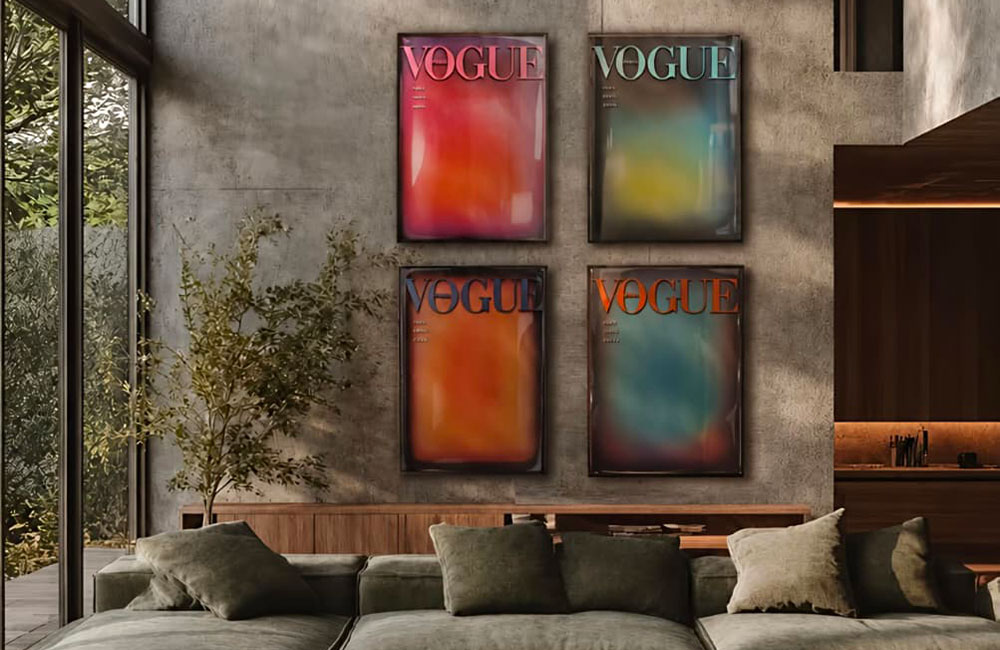
The project originates from an immediately recognizable format: that of a magazine cover. Yet what appears familiar is removed from its original function. The photograph, the model, the headlines and the editorial content disappear; what remains is the logotype, isolated, transformed into a physical presence and immersed in an unstable chromatic field. The gradient is not decorative, but an open pictorial space: a shifting, undefined light that recalls sfumato, colour fields, and painting’s inability to define completely.
It is within this tension between symbol and painting that the critical core of the work emerges. The logo, produced with mechanical precision and uniform thickness, preserves the industrial coldness of mass desire; the background, by contrast, breathes, changes and absorbs. On one side stands the absolute nature of the brand; on the other, the indefiniteness of light. Resin makes this contradiction material: it reflects the viewer, incorporates the surrounding space, and turns the work into an open system. The viewer does not remain outside the image, but enters it physically. Every magazine is a dream that a culture has constructed for someone: before the work, that someone becomes the viewer. The project engages with Debord, Baudrillard, Barthes, Merleau-Ponty and Benjamin: the magazine as spectacle, simulacrum, cultural myth and device of reproduction. Here, however, the serial symbol is returned to matter, light, shadow and the uniqueness of perceptual experience. The spectacle is shown after its end; the myth is dismantled not by being destroyed, but by being suspended within a silent painting. As print media decline, these works operate as contemporary vanitas: they capture desire at the moment when its historical medium begins to wither.
When the face, the article, and the desire disappear, only the logo remains. A pure, empty, and immaculate symbol: the spectacle no longer in need of the spectacle itself.